Cannabis Breeding Techniques Every Grower Should Know
- Written by: admin
- Category: Uncategorized
- Published: June 2026
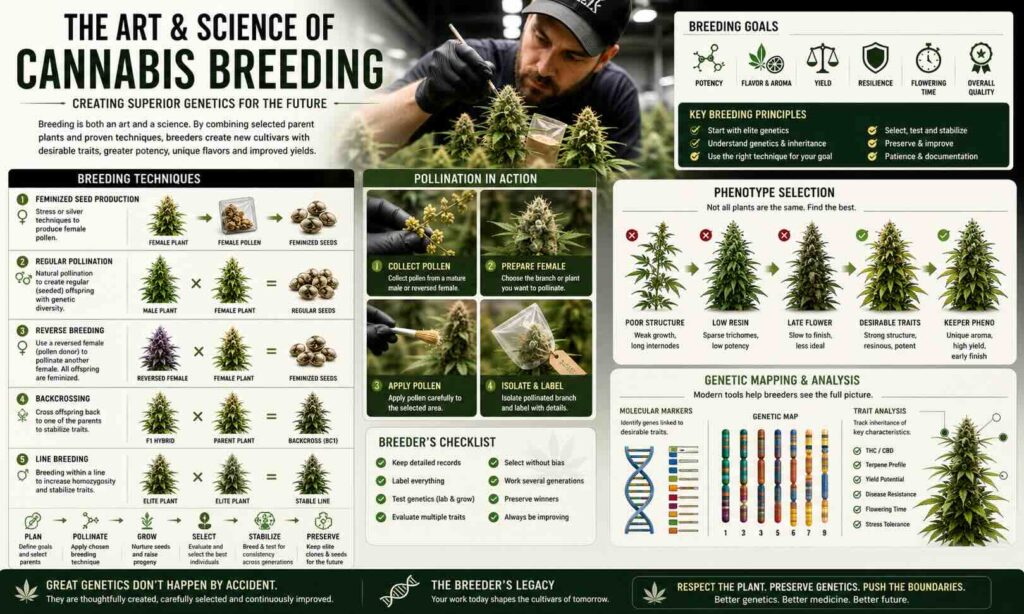
Cannabis breeding has played a fundamental role in the development of the diverse cultivars available today. While many growers focus primarily on cultivation techniques, understanding the basics of breeding provides valuable insight into how modern genetics are created, refined, and preserved. Even growers who have no intention of launching breeding projects can benefit from learning how selection and genetic improvement shape the plants they cultivate.
Modern breeding combines observation, planning, selection, and patience. Through multiple generations of refinement, breeders work to stabilize desirable characteristics and improve overall consistency. The result is a continuous process of genetic development that drives innovation throughout the cannabis industry.
Selective Breeding
Selective breeding is one of the oldest and most important breeding techniques. The process involves identifying plants that display desirable traits and using them to create future generations. Over time, repeated selection helps strengthen those characteristics within a genetic line.
Traits such as vigor, stability, structure, adaptability, and overall cultivation performance are commonly evaluated during selection. By choosing the strongest candidates generation after generation, breeders gradually improve consistency and predictability.
This technique remains one of the foundations of modern cannabis breeding.
Nearly every successful cultivar has benefited from careful selection over multiple generations.
Phenotype Hunting
Phenotype hunting refers to growing multiple plants from the same genetic population and evaluating them individually. Because each seed contains a unique combination of genetic information, variation can occur even within the same cultivar.
Breeders use phenotype hunting to identify exceptional individuals that express particularly desirable characteristics. These selected plants may then be incorporated into future breeding projects.
The process requires careful observation and detailed record keeping. Small differences between plants can become important when selecting breeding stock.
Phenotype hunting remains one of the most effective ways to discover outstanding genetics.
Backcrossing and Stabilization
Backcrossing is a technique used to reinforce specific characteristics within a genetic line. It involves crossing offspring back to a parent or closely related plant that displays a desired trait. This helps increase the likelihood that future generations will express those characteristics.
Stabilization often follows multiple generations of selection and backcrossing. The objective is to reduce variability and create a cultivar that performs consistently over time.
Reliable genetics are the result of extensive refinement rather than chance alone. Stability remains one of the most important goals within professional breeding programs.
Consistent cultivars provide growers with greater predictability and confidence.
Hybridization
Hybridization involves crossing plants from different genetic backgrounds to combine desirable characteristics into a single cultivar. This technique dramatically expanded the possibilities available to cannabis breeders and helped create the diverse range of modern cultivars available today.
Hybrid projects often seek to combine complementary traits while maintaining overall balance and performance. Successful hybridization requires careful planning and extensive evaluation across multiple generations.
Growers interested in exploring modern cannabis genetics can learn more through https://www.ministryofcannabis.com/fr/. Understanding hybridization helps cultivators appreciate the complexity behind contemporary breeding projects.
Many of today’s most successful cultivars are the result of decades of hybrid breeding.
The Role of Observation and Record Keeping
Regardless of the breeding technique used, observation remains one of the most valuable tools available. Detailed records help breeders track inheritance patterns, evaluate plant performance, and make informed decisions throughout a project.
Accurate documentation becomes increasingly important as breeding programs expand across multiple generations. Without reliable records, valuable information can easily be lost.
Additional information regarding cannabis science and cultivation can be explored through https://www.weedside.story/category/science/.
The combination of observation, patience, and careful documentation continues driving genetic improvement throughout the cannabis industry.
Final Thoughts
Cannabis breeding techniques such as selective breeding, phenotype hunting, backcrossing, stabilization, and hybridization have shaped the modern cannabis landscape. These methods allow breeders to refine genetics, improve consistency, and preserve valuable traits for future generations.
Even growers who focus exclusively on cultivation can benefit from understanding these techniques. A deeper appreciation of breeding helps explain why genetics remain one of the most important factors influencing cannabis performance and development.